21 Advanced Unsupervised Techniques
21.1 Introduction
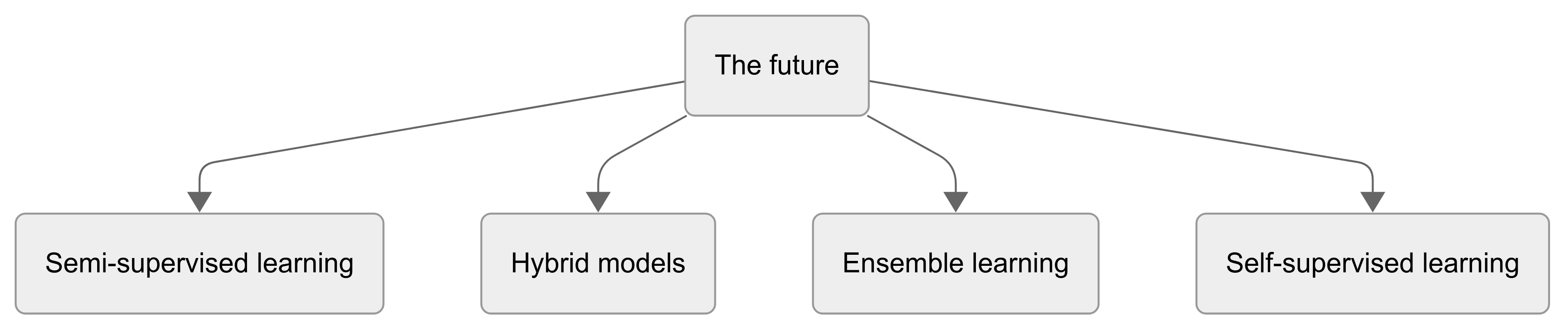
In this final chapter, we’ll examine some contemporary developments in machine learning (including integrative approaches and hybrid models) and consider how these might offer useful insights when applied to sport data.
Machine learning has evolved significantly over the past decades. Supervised learning, which relies on labeled data, continues to be used for tasks such as classification and regression, while unsupervised learning uncovers hidden patterns in unlabeled data through clustering and dimensionality reduction techniques.
However, these traditional approaches often face limitations, particularly when labeled data is scarce or when a combination of strategies could yield better results.
Integrative approaches, hybrid models, and semi-supervised learning address these challenges by blending different machine learning paradigms to improve efficiency and accuracy.
21.2 Semi-Supervised Learning
‘Integrative’ approaches combine multiple machine learning paradigms to enhance performance, adaptability, and efficiency. They merge different models or strategies to leverage respective strengths and mitigate weakness.
One example of integrative machine learning is semi-supervised learning. This approach sits between supervised and unsupervised learning, leveraging both labeled and unlabeled data. It’s particularly useful when obtaining labeled examples is costly or time-consuming, but large amounts of unlabeled data are readily available.
Semi-supervised learning techniques include:
Self-training, where a model initially trained on labeled data generates pseudo-labels for unlabeled examples, which are then used for further training;
Consistency regularisation, which encourages the model to produce stable predictions even when input data is slightly perturbed; and
Graph-based techniques, which propagate labels across connected data points.
Semi-supervised learning is currently applied in various domains (such as medical diagnosis) where labeled patient records are limited, and speech recognition, where transcribed data is expensive to obtain.
21.3 Hybrid Models
Hybrid models combine supervised and unsupervised learning techniques to maximise the strengths of both approaches.
One example is the cluster-and-classify method, where clustering algorithms first group similar data points, and then a supervised model is trained on these clusters to make predictions.
Another technique, covered in Chapter 20, involves using autoencoders (a type of neural network that learns compressed representations of data) to extract meaningful features before applying a classification model.
Unsupervised methods, such as dimensionality reduction techniques (e.g., principal component analysis) can help simplify high-dimensional data, making it easier for supervised models to process.
Hybrid approaches are currently used in fraud detection, where anomaly detection methods identify suspicious transactions before they are classified, and in image recognition, where unsupervised feature extraction improves classification accuracy.
21.4 Ensemble Learning and Meta-Learning
Beyond these combinations, ensemble learning (which we covered previously) and meta-learning provide further opportunities for integrating machine learning techniques.
Ensemble learning improves prediction accuracy by combining multiple models, reducing the likelihood of errors that might occur when relying on a single model (see Chapter 19):
Bagging methods, such as random forests, train multiple models on different subsets of data and aggregate their predictions
Boosting techniques, like gradient boosting, iteratively improve weak models by focusing on misclassified examples.
Stacking takes integration further by training a meta-model to learn how best to combine several base models.
Meanwhile, meta-learning, often described as learning to learn, enables models to adapt to new tasks with minimal training data. Few-shot learning, a form of meta-learning, is particularly useful when labeled data is scarce and is commonly applied in areas such as medical imaging and robotics.
21.5 Neural-Symbolic and Self-Supervised Learning
Advances in integrative techniques have also led to the development of neural-symbolic learning and self-supervised learning.
Neural-symbolic learning merges deep learning with symbolic reasoning, allowing AI systems to incorporate logical rules alongside statistical learning. This is particularly beneficial in applications requiring explainability, such as medical diagnosis and legal decision-making.
Self-supervised learning, on the other hand, eliminates the need for manually labeled data by designing pretext tasks that enable models to learn from data itself.
Contrastive learning, an important self-supervised approach, trains models to distinguish between similar and dissimilar data points, as seen in modern language models like BERT and image processing frameworks such as SimCLR.
These all demonstrate the growing importance of integrative techniques in making AI systems more robust and adaptable.
21.6 Final Thoughts
Integrative approaches and hybrid models provide with powerful tools to overcome the limitations of traditional methods. By combining supervised, unsupervised, and semi-supervised learning techniques, analysts can develop more flexible and efficient models suited to real-world challenges.
As machine learning continues to evolve, and its usefulness in sport data analytics becomes more widely realised, the role of hybrid and integrative techniques will become increasingly central in building intelligent systems that are both effective and adaptable and offer the possibility of more in-game analytics, learning and updating almost instantaneously.